
There's a widespread misconception in retail that upselling means pushing customers to spend more. In reality, upselling is suggesting a product that better solves the customer's stated need. Cross-selling is adding complementary products that enhance the primary purchase. When done well, both increase average transaction value while simultaneously improving customer satisfaction.
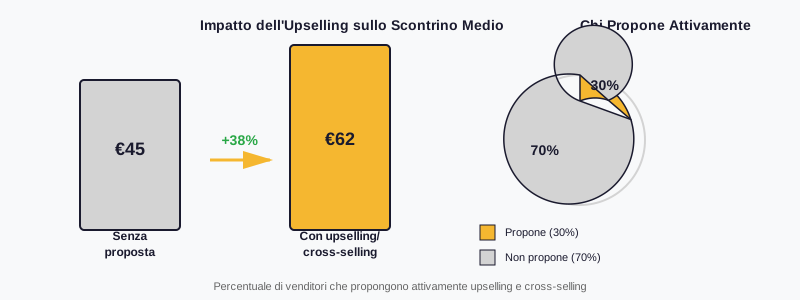
The key is understanding the difference and executing each strategy at the right moment, with the right products, for the right reason. Our mystery shopping data covering 21 years shows that only 30% of retail staff actively propose complementary or upgraded options. Of those who do, 60% use ineffective approaches that trigger customer resistance. But the 10% who execute properly drive 25-30% higher average transaction values.
Understanding the difference: upgrade, cross-sell, and add-on
Before we talk strategy, we need clarity on terms. Three distinct techniques are often lumped together as "upselling," but they're meaningfully different.
Upselling (or upgrading) means proposing a higher-value version of the product the customer has already decided to purchase. The customer wants a black t-shirt; you propose the premium cotton version at 30% higher price. The customer is buying basic tools; you suggest the professional-grade equivalent. The customer's need remains the same; you're recommending a better solution.
Cross-selling means adding a complementary product. The customer is buying running shoes; you suggest moisture-wicking socks. The customer is purchasing a coat; you propose the matching scarf. The customer is acquiring tools; you suggest the maintenance kit. These are genuinely separate purchases addressing different needs, but they naturally pair together.
Add-ons are smaller-ticket items that enhance the primary purchase. The customer buys a phone; you suggest the screen protector. The customer purchases a sweater; you mention the fabric refresher spray. Add-ons rarely increase perceived value; instead, they prevent future problems or improve product lifespan.
25-30%
Average ticket increase with effective upselling and cross-selling
30%
% of staff who actively propose complementary products
Each requires different timing and framing. Understanding which technique applies to your situation is the first step toward execution that doesn't feel like pressure.
The three critical moments for complementary proposals
When you propose matters as much as what you propose. There are three moments in the customer journey where additional product suggestions are well-received and effective.
Moment one: During needs discovery. When the customer is still describing what they want, you have maximum opportunity to understand context and naturally suggest complementary solutions. "You're buying this for outdoor use?" opens space to propose protective treatments. "This is a gift?" allows you to suggest beautiful packaging or a complementary item. The proposal emerges naturally from the conversation, not as a separate push.
Moment two: When confirming the primary decision. The customer has committed to the primary purchase. They've said "yes" to the product, and their mental state is positive and forward-moving. This is the highest-probability moment for accepting complementary proposals. "Since you're investing in this quality, you might want the protectant to preserve it." The suggestion aligns with the value principle they've already accepted.
Moment three: At checkout, only as a natural question. This is the weakest moment for proposals, but it can work if framed as a simple, guilt-free option. "Did you want to grab socks with those shoes?" or "Need a bag for this?" These work because they're low-pressure logistical questions, not sales pushes. They work particularly well for obvious pairings where non-purchase feels like an oversight.
Mystery shopping data shows that proposals at moments one and two succeed 40-50% of the time. Proposals at moment three succeed only 15-20% of the time, and in some cases damage the positive transaction experience when customers perceive them as aggressive final pushes.
Sector-specific techniques that actually work
Different retail sectors have different product ecosystems and customer mindsets. What works in apparel fails in electronics. What works in hardware fails in beauty. Understanding your sector's specific dynamics is essential.
Apparel and fashion. Cross-selling works exceptionally well here because customers think in outfits and complete looks. The customer buying a blazer naturally benefits from shirt recommendations. The customer buying pants profits from shoe suggestions. The approach that works: "What are you pairing this with?" This question naturally opens space for complementary suggestions without feeling like pressure. Upselling also works well—suggesting premium materials or fit levels—because customer investment in appearance is inherently quality-conscious.
Electronics and technology. Add-ons work exceptionally well (screen protectors, cases, cables) because customers recognize these as genuine protective needs. Cross-selling works moderately ("This pairs well with...") but customers often research complementary tech independently. Upselling requires careful framing—customers often suspect you're pushing margins rather than suggesting improvements. The approach that works: lead with function. "This model has the processor you need for that software" is stronger than "This costs more and is better."
Home and furniture. Cross-selling is powerful because customers are typically furnishing rooms rather than buying individual items. "What else are you planning for this room?" opens space for complementary suggestions. Upselling works when framed around durability and longevity rather than luxury. "The premium option lasts twice as long" resonates better than "It's the nicer version."
Beauty and personal care. Add-ons work very well because customers see product systems—cleanser with moisturizer, foundation with primer. Cross-selling works extremely well because products are typically used together. The approach that works: lead with benefits to the primary purchase. "This serum works beautifully under your new moisturizer" frames the add-on as enhancement rather than additional expense.
Sports and outdoor equipment. Upselling and add-ons work exceptionally well because customers recognize the performance and safety value. Protecting an investment resonates strongly. "Your new shoes will last much longer with this treatment" is a natural proposal. Cross-selling works when related to function: "These socks prevent the blisters that come with new shoes."
The objection handling framework: "Not interested" doesn't mean no
The most common error staff make with upselling is accepting the first "no." The customer says "Not interested," and staff move straight to checkout. In reality, "not interested" often means "not yet informed enough to see the value."
Effective objection handling follows a simple pattern: acknowledge, explain benefit, offer choice. "I understand—most people skip these initially, but the protection extends life by years. Want to add it?" This is non-aggressive. You've acknowledged their hesitation, explained actual benefit, and given them a clear choice. It's remarkably effective without being pushy.
The second objection handling moment is price. If customers say "It's too expensive," don't defend the price. Instead, reframe value. "I get it—what I'd suggest is that the premium fabric lasts three seasons instead of one, so the cost per wear is actually lower." You're not arguing; you're providing information the customer genuinely might not have.
Mystery shopping data shows that a single gentle follow-up to an initial objection increases acceptance from 5% to 25-30%. A second follow-up increases it to 35-40%. But a third attempt triggers resistance and damages the transaction. The sweet spot is two attempts maximum, executed with genuine information and respect for customer autonomy.
What kills upselling effectiveness: the practices to avoid
There are specific behaviors that destroy upselling effectiveness and damage customer experience. Avoid these religiously.
Proposing products you wouldn't personally buy. Customers sense inauthenticity instantly. If you're proposing a product primarily because your store profits from it, your tone and confidence communicate that. Your belief in the product's value is the difference between a suggestion and a push.
Proposing products unrelated to stated needs. The customer buys a winter coat. Proposing a summer hat triggers resistance because the benefit isn't obvious. Proposing the matching winter scarf feels like a natural completion. Relevance is everything.
Proposing too many things at once. When staff list three add-ons and two cross-sells, customers feel overwhelmed and shut down entirely. The approach that works: one suggestion, maximum two if they're obviously complementary.
Proposing before understanding the primary purchase. If you suggest items before the customer has fully committed to the base product, they perceive the proposals as part of an upselling strategy, not genuine suggestions. Wait until decision commitment is clear.
Persisting after clear refusal. If a customer has explicitly declined a suggestion and you propose it again in different words, you're not being persuasive—you're being annoying. One clear "no" should end the proposal.
The integration with customer experience: upselling without alienation
The highest-performing retail operations we've observed across 21 years share a critical insight: upselling and cross-selling aren't separate from customer experience. They're part of it. When executed as genuine suggestions rooted in understanding customer needs, they enhance the experience. When executed as sales tactics, they damage it.
This distinction is entirely attitude-driven. If your frame is "I want to help this customer get the best solution for their needs," upselling feels like service. If your frame is "I need to increase this transaction," it feels like pressure. Customers detect the difference.
The highest-performing networks train staff to see complementary product proposals as completing the solution the customer is already buying, not as separate sales. The customer bought running shoes? You're not trying to sell socks—you're helping them have the complete running experience. That frame changes everything about execution.
Master upselling and cross-selling for your team
Best Seller training includes specific modules on upselling techniques, objection handling, and sector-specific strategies—reinforced through repetition and gamified practice.
Request a demo