
The customer walks in. An eight-second window. In that window, the difference between a sale and a lost opportunity, between a positive experience and a missed interaction, is entirely determined by whether the store team engages or ignores. This is where most retail transactions are decided, before a word about products is spoken.
Understanding and mastering the complete customer journey in retail—from those critical first seconds through to post-purchase loyalty—transforms performance metrics across the network. This guide maps the complete journey, rooted in 21 years of mystery shopping observation across thousands of retail interactions.
The eight-second rule: why the greeting is everything
When customers enter a retail space, neuroscience tells us they assess the environment and staff behavior within eight seconds. This isn't a marketing claim—it's been observed and measured across multiple retail contexts. The brain makes rapid judgments: Do staff notice me? Are they open to interaction? Is this place worth lingering in?
Our mystery shopping data shows a stark pattern: stores where staff engage within the first eight seconds see 40% higher conversion than those where engagement happens after a minute or where no engagement occurs at all. This isn't subtle. It's a fundamental driver of sales outcomes.
The greeting itself doesn't need to be complex. "Welcome in" or "Feel free to ask if you need anything" delivered with genuine eye contact and a smile converts. What fails systematically is invisible staff, staff absorbed in devices or conversations, or staff that wait for the customer to approach first. Retail data is consistent: customers don't approach staff to initiate conversation. Staff initiate engagement with customers.
8 seconds
Time window for customer assessment of staff responsiveness
40%
Higher conversion rate with early engagement vs. late or absent
The greeting also sets behavioral tone. A proactive welcome signals the store is attentive and customer-focused. It gives implicit permission for the customer to ask for help later. Absence of greeting signals the opposite: customers assume they're interrupting if they approach with questions.
Engagement: moving from greeting to conversation
After the greeting, the second critical phase is engagement—moving the customer from "I'm browsing" mode to active conversation. This is where most retail staff struggle. They assume the customer should approach with specific requests or questions. In reality, customers are often uncertain about what they want, comparing options, or exploring without a clear goal.
Effective engagement starts with observation. What product category is the customer drawn to? How are they moving through the store? Are they comparing items? This observational data tells you where to focus the conversation without making assumptions.
The next step is the open question. Not "Can I help you find something?" (which prompts "No, just looking" and conversation ends), but rather "What brings you in today?" or "Looking for anything specific?" These questions invite elaboration, creating space for the customer to share needs or constraints.
Our mystery shopping data shows that 65% of stores fail at this engagement phase—staff provide greeting but don't convert to actual conversation. They acknowledge presence but don't move toward understanding what the customer might want.
Needs discovery: asking the right questions
Once conversation begins, the temptation is to talk about products. This is where many retail interactions fail. Customers don't want to hear about inventory; they want solutions to problems or satisfaction of desires. Discovering what those problems or desires are requires structured questioning.
Effective needs discovery follows a pattern: broad to narrow, open to closed. Start with understanding the customer's situation or goals. "Are you looking for something specific, or just browsing for ideas?" Then narrow based on responses. "Is this for yourself or a gift?" Then refine further toward actual need. "What's most important to you—durability, style, or price?"
This process accomplishes something crucial: it shifts the customer's perception from "I'm being sold to" to "someone is trying to understand what I actually want." Research on customer experience consistently shows this perception shift is a primary driver of purchase intent.
The trap staff fall into is what we call "feature pitching before need." The staff member launches into product specifications, colors available, seasonal styles—all completely irrelevant if the customer doesn't yet understand their own needs. The customer disengages mentally and defaults to "just browsing."
Product presentation: features, benefits, and context
Once you understand what the customer actually needs, product presentation becomes relevant and effective. The key distinction here is between features and benefits, and more importantly, between benefits and context.
A feature is factual: "This fabric is 100% cotton." A benefit is personal: "This means it breathes in warm weather, so you'll stay comfortable." Context is emotional and relational: "That's why people who work outdoors prefer this material."
Mystery shopping data shows that stores presenting only features see lower engagement than those adding benefits. But stores that add context—connecting the product to customer situations—see the highest conversion. The customer isn't just informed; they're seeing themselves in the product.
Effective product presentation also involves comparison. Not hard selling, but honest comparison. "If you want lightweight, this style is better. If you need durability for heavy use, this one is the choice." This honesty builds trust. The customer feels you're serving their interests, not pushing inventory.
Upselling and cross-selling: adding value, not pushing
After the customer has committed to a purchase, the upselling and cross-selling window opens. This is where most retail networks see significant performance variation and, frankly, where staff often become uncomfortable.
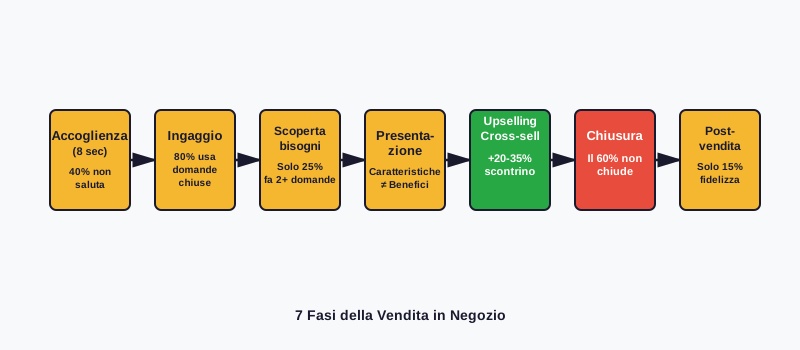
The key to successful upselling is that it follows naturally from the needs discovery conversation. If you understand what the customer wants, proposing complementary items isn't pushing—it's completing the solution. "Since you're buying this for outdoor use, you might want this protective spray to extend the life. It's inexpensive and really protects the investment."
The data is clear: stores where staff don't propose complementary products show lower average transaction value. Stores where staff do propose them, but in a way that feels natural from the conversation, show 25-30% higher average transaction value. Stores where pitches feel forced or irrelevant show lower conversion on the upsell itself and damage the primary sale perception.
Timing matters. The best moment for upselling is immediately after the customer has verbally committed to the primary purchase—when they're in a positive mental state and momentum is forward. Proposing it too early feels like pressure. Proposing it too late (at checkout) feels like a final push with no room to absorb the suggestion.
The closing: moving intent to transaction
Many retail interactions stall at the final stage—the customer has decided to buy, the staff member understands what needs to happen, but the transaction doesn't close because no one initiates the path to checkout.
The closing is straightforward: confirm the decision ("This looks like the right choice?"), offer alternative ways to pay or delivery options if relevant, then move to the register with positive momentum. The psychological element here is crucial—staff who seem confident in the decision create a mirror effect in the customer. Hesitation or uncertainty about the purchase undermines the decision the customer has already made.
Our data shows 8% of customer-engaged interactions fail at close—the customer leaves without purchasing despite clear purchase intent. The reason is almost always unclear next steps or staff inaction rather than customer indecision.
Post-purchase: the loyalty opportunity most stores miss
The transaction doesn't end at checkout. In fact, the moment a customer completes a purchase is one of the highest-value moments for creating loyalty, yet it's where most retail operations completely disengage.
Effective post-sale behavior involves several elements: confirming satisfaction ("I think you'll love this"), providing relevant care information if applicable, creating a transition to repeat purchasing ("When you need refills, we have a loyalty program"), and genuinely wishing the customer well as they leave.
Mystery shopping consistently shows that 70% of stores provide no meaningful post-purchase engagement. The customer leaves without any sense that the store values future visits. The implication they receive is transactional: you paid, transaction complete, thank you goodbye.
By contrast, stores that provide genuine post-purchase attention see 30% higher repeat visit rates. This isn't complex—it's primarily attention and genuine courtesy. "I hope that works perfectly for you" or "Come back and let me know how you're getting on with it" costs nothing and generates loyalty momentum.
The complete journey: integration and consistency
What makes the difference between high-performing networks and average ones isn't excellence in any single phase of this journey—it's consistency across all phases. A customer who receives a warm greeting but then no needs discovery feels abandoned. A customer who receives excellent needs discovery but then hears features without benefits disengages. A customer who feels pressured into an upsell negates the positive experience from everything before it.
This consistency doesn't happen by accident. It requires clear training, reinforcement through mystery shopping feedback, and ongoing coaching. Staff need to understand the journey, see their role in each phase, and receive data showing how their behavior at each stage affects outcomes.
The highest-performing networks we've observed over 21 years share a common pattern: they treat the customer journey as a system, not as individual moments. Training reinforces the full journey. Performance metrics track behavior at multiple stages, not just final sales. And staff understand how their greeting connects to close, how their engagement connects to post-sale loyalty.
Transform your store's customer journey
See how Best Seller training covers every phase of the in-store journey with short, reinforced, gamified content that actually sticks with your team.
Request a demo