
Ask a retail manager how much they spend on staff training and you'll almost certainly get a partial figure. The cost of the trainer, perhaps the training venue. But the real bill is quite different, and significantly higher than what appears in the budget.
Anyone managing retail networks knows from direct experience: organizing a training session means closing or understaffing stores, paying for travel, covering shifts, and booking spaces. Then there's time — hours of paid labor when staff aren't selling. And finally, there's the factor that nobody puts in the spreadsheet but that weighs more than everything else: turnover.
The costs everyone can see
Traditional retail training is built on classroom sessions. One trainer, a group of sales staff, one day (or half-day) away from the store. The direct costs of this model are well known and easily quantifiable: trainer fees, venue rental if you don't have internal space, training materials, catering if the session runs all day.
For a standard classroom session with 10-15 people, direct costs typically fall between €2,000 and €5,000. Multiply that by the number of sessions needed to cover your entire network, and by the frequency required (at least two cycles a year for most retailers), and you quickly reach significant figures. But these are only the costs that appear on invoices.
The invisible costs: what doesn't show up in the budget
The true economic weight of traditional training lies in indirect costs — those with no dedicated invoice and thus escape management oversight.
$1,000-1,900
Cost per person per training cycle, including indirect costs
3-4 weeks
Average time to make a new hire productive with traditional training
30-50%
Annual turnover rate in retail
The first invisible cost is lost sales. Every sales associate in training is one not selling. In a network of 50 stores with 3-4 staff per store, training everyone for one day means hundreds of lost selling hours. For a store with average daily sales of $3,000 and three staff members, pulling one for a day's training equals losing roughly one-third of sales capacity. Multiply across the entire network and lost sales from a single training cycle easily exceed tens of thousands of dollars.
The second cost is travel and logistics. Moving people from stores to a training location costs money: transportation, potential meals and accommodation for remote participants, paid travel time. For chains with national coverage, this becomes a significant multiplier, especially if training is centralized.
The third cost, often the most underestimated, is shift coverage. If a staff member is in training, someone must cover their store shift. This might mean overtime for colleagues, temporary staffing costs, or simply a store operating below capacity for the day — with direct effects on service quality and customer experience.
The multiplier nobody wants to calculate: turnover
Staff turnover in retail is a structural fact of the industry. Recent estimates place annual rotation between 30-50% for sales staff, with peaks exceeding 80% for those under 25 and part-time positions. The average tenure for a sales associate in retail is about 14 months, dropping to 4-6 months for younger workers.
This means a significant portion of training investment is systematically wasted. Not because training failed, but because trained employees leave and take their acquired knowledge with them. The real cost per competency actually retained in the organization is therefore double or more the nominal cost.
There's an even more insidious aspect: turnover isn't evenly distributed. It concentrates in the first months after hire, precisely when training investment is freshest and return still minimal. An associate who leaves after three months has received full initial training but generated insufficient value to repay the investment.
The forgetting curve: the cost of what's lost
Even when staff stay, classroom training has a structural problem with knowledge retention. Research on memory — starting with Ebbinghaus's work on the forgetting curve — shows that without reinforcement, 70% of learned information is forgotten within 24 hours and over 90% within a week.
In retail practice, this translates to a recognizable pattern: the week after a course, behavior improves; after two weeks the improvement fades; after a month you're back to old habits. We see this pattern consistently in mystery shopping visits following training cycles. The post-training performance peak exists but decays rapidly without reinforcement.
Classroom training, by its nature, delivers massive content in compressed time. The human brain isn't designed to retain information this way. Micro-learning — breaking content into brief, repeated units over time — produces significantly better retention precisely because it distributes learning in a way compatible with how memory works.
The complete calculation: what it actually costs
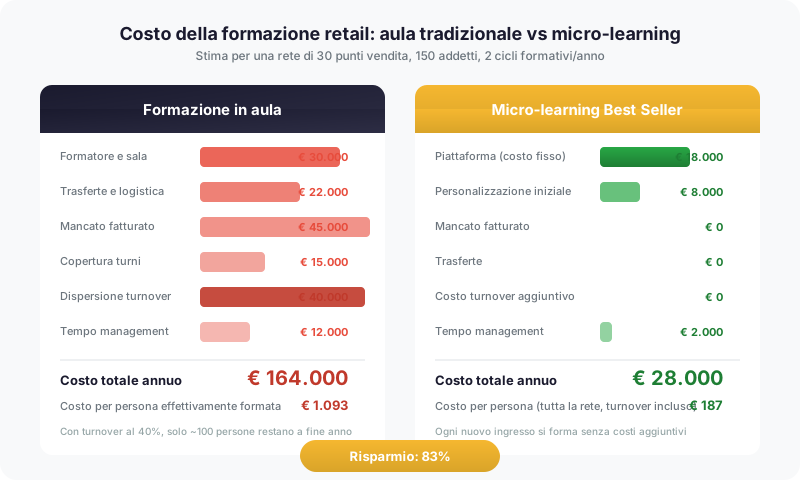
Putting all these factors together, the true cost of traditional training for a retail associate falls between $1,000 and $1,900 per training cycle. This includes direct costs (trainer, venue, materials), indirect costs (lost sales, travel, shift coverage) and the share of investment dispersed through turnover.
For a chain of 30 stores with an average 5 staff per location (150 people), two annual training cycles means total investment between $300,000 and $570,000. Of this amount, at least one-third is structurally dispersed due to turnover effects.
Add to this the opportunity cost: the time management spends organizing training logistics (notifications, shift planning, venue booking, trainer coordination) is time lost to more strategic activities.
The alternative: fixed-cost training that doesn't repeat
An alternative model exists and is being adopted by a growing number of European retail chains: digital micro-learning via smartphone, consumed during downtime, without interrupting sales operations.
The structural economic advantage is fixed cost. Unlike classroom training where each cycle is a new expense and each new hire is additional cost, a micro-learning platform has cost independent of turnover. If a staff member leaves after three months, the next hire follows the same training path at no additional cost to the company. Cost per competency retained converges toward nominal cost, eliminating the turnover multiplier.
The second advantage is elimination of indirect costs. No travel, no venues, no understaffed stores. Staff train via smartphone in dead time — between customers, before opening, during breaks. The store stays open and productive.
The third advantage is retention. Brief content distributed over time, with quiz reinforcement and repetition, structurally counteracts the forgetting curve. It's not about hoping staff remember what they heard in class three weeks ago: it's a system that continuously reintroduces, tests and consolidates competencies.
Want to know how much your network could save?
Tell us about your network size and we'll show you a personalized comparison between current costs and the Best Seller model.
Request a free comparison