
A customer walks in. Within 8 seconds, a sales associate has acknowledged them or hasn't. That simple moment — the greeting — determines whether the interaction trajectory points toward a sale or toward a distant, transactional exchange. The data is clear: how you greet a customer strongly predicts whether they'll buy.
We've evaluated thousands of retail encounters through mystery shopping across fashion, food, electronics, and beauty sectors. The patterns are consistent. The quality of the greeting is among the strongest signals of eventual conversion. Not the only signal, but one of the strongest. And unlike many things in retail, it's completely teachable.
What mystery shopping reveals about the greeting
In mystery shopping evaluations, we observe the exact moment a customer enters. How long until they're acknowledged? What's the tone of the acknowledgment? Is it genuine or scripted-sounding? Does the associate make eye contact? What happens next?
8 seconds
Average time to optimal greeting from customer entry
37%
Increase in conversion when greeting happens within 10 seconds
62%
Stores where customers go ungreeted for 30+ seconds
The data shows a sharp correlation between greeting speed and purchase probability. When a customer is acknowledged within 10 seconds — a warm acknowledgment, not just "let me know if you need anything" barked from the back — conversion increases by roughly 37%. When acknowledgment is delayed beyond 30 seconds or absent entirely, customers shop mechanically and leave without asking questions or seeking assistance.
The greeting also strongly predicts the tone of the rest of the interaction. A hesitant, mumbled greeting usually leads to a distant interaction. A confident, warm greeting opens the customer toward engagement. The greeting is the pivot point.
The anatomy of an effective greeting
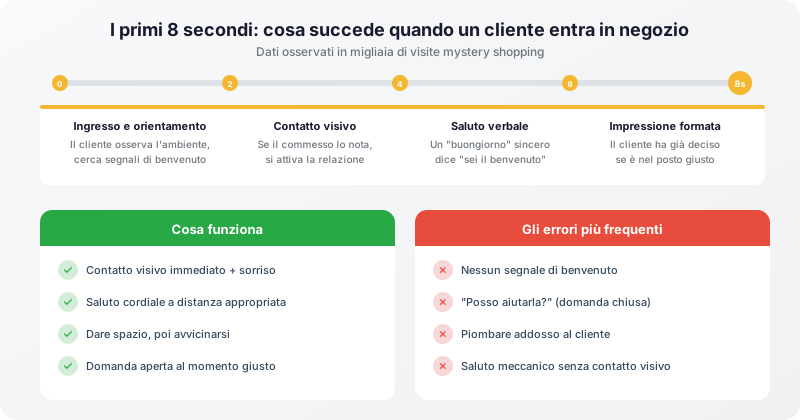
An effective greeting has three components: immediacy, warmth, and relevance. It happens fast — within the first 10 seconds of customer entry. It's delivered with genuine tone, not robotic script compliance. And it's relevant to what the customer is doing, not generic filler.
Instead of "Let me know if you need anything," which politely signals the associate is unavailable, effective greetings sound like: "Hi, welcome! Are you looking for something specific today, or just browsing?" The difference is subtle but measurable. The first closes conversation. The second opens it.
Sector-specific patterns
The greeting that works varies by sector. In fashion retail, speed and warmth matter most — customers are in a browsing mindset and need permission to engage. In electronics, expertise signals matter more — customers want to know if this person can help them make a technical decision. In beauty, product-specific reference works — "Are you looking for skincare today or makeup?" positions the associate as knowledgeable.
The commonality across sectors: the greeting must be fast, delivered with genuine tone, and open-ended enough that the customer can express their actual need rather than being steered toward what the associate assumes they want.
What derails the greeting
Common mistakes we observe in mystery shopping: associates who are so busy restocking or working the register that they don't see the customer for 30+ seconds. Associates who mouth greetings without looking up or making eye contact. Associates who deliver the greeting in a tone that says "please don't need anything." Associates who greet correctly but then immediately pivot to selling or questioning rather than listening.
The worst pattern: the non-greeting. The customer enters, no acknowledgment happens, and they proceed to shop alone. This is surprisingly common in stores where staff are understaffed or where management hasn't made the greeting a procedural expectation.
Training the greeting effectively
The greeting is fundamentally a skill, not an attitude. You can't train people to "be warmer" in the abstract. You train them to do specific things: "When a customer enters, pause what you're doing. Look up and make eye contact within 5 seconds. Say 'Welcome to [store]' or use your store's greeting words. Smile. Then ask an open question: 'What brings you in today?' or 'Are you looking for something specific?' Then listen to the answer."
Scripting the greeting doesn't create robotic interactions — it creates consistency and removes the decision-making load from staff in high-stress moments. A script gives you something to practice and measure. After staff practice and internalize the script, it becomes natural and personal.
Role-playing the greeting with immediate coaching is far more effective than lectures or videos about the importance of greeting. Staff need to practice the actual words, the tone, the eye contact. They need to feel how it lands.
The greeting-to-conversion connection
Why does a greeting matter so much? Because it's the moment the customer decides whether the associate sees them as a person or is treating them as an interruption. A prompt, warm greeting says "I'm here for you." A delayed or indifferent greeting says "I'm here but you're not my priority." Customers respond to that signal immediately, often unconsciously. If they feel welcomed, they ask questions and give associates permission to help. If they feel like an interruption, they self-serve and leave.
The greeting is also the moment the associate signals competence. A confident, warm greeting from someone who clearly knows their job and is present establishes credibility. A hesitant greeting from someone who seems distracted or uncomfortable communicates lack of confidence, which transfers to the customer.
Implementation: from insight to daily practice
Knowing this matters doesn't change behavior without deliberate practice. The implementation step requires: defining your store's greeting words (brief, specific script), training all staff on the exact words and the tone, incorporating greeting evaluation into mystery shopping or manager observations, and recognizing staff who do it well. This isn't one training session — it's continuous reinforcement and feedback.
The ROI is straightforward: a 37% conversion improvement from better greetings in a store with 50 customer transactions daily is 18 additional daily sales. At an average transaction of $45, that's $810 additional daily revenue. Annual impact from getting greeting right: roughly $295,000 in a single store location.
Want to measure your greeting impact?
We can conduct a greeting audit across your network and show you the conversion difference. Let's talk about your specific sector and customer base.
Request a greeting audit