
A typical retail store today is a multigenerational workplace. You have Baby Boomers in their 60s, Gen X in their 50s, millennials in their 30s and 40s, and Gen Z in their 20s — sometimes all on the same team. Each cohort brings different work styles, different motivations, different learning preferences. And they all need to learn the same product knowledge and selling techniques.
Traditional training treats this diversity as a problem to solve by forcing everyone into one format: group classroom sessions, usually presented by someone from a different generation, with methods that work well for nobody. The result: poor engagement across the board, especially among Gen Z who find classroom training particularly alienating.
But the multigenerational challenge is solvable with the right approach — one that respects how different cohorts actually learn.
Why one-size-fits-all training fails
A Baby Boomer might prefer comprehensive, in-depth training delivered by a knowledgeable instructor. They want context, history, and hierarchical structure. A Gen Z worker wants quick, practical tips delivered via video, with autonomy over when and where they learn. A millennial values peer feedback and integration with other tools they already use.
Classroom training optimizes for neither. It's inefficient for people who prefer video. It's too compressed for people who prefer depth. It pulls people from the sales floor at times inconvenient for scheduling. And it's expensive — especially when you need to run multiple sessions to accommodate everyone.
The underlying problem: One-size-fits-all training assumes everyone learns the same way and at the same pace. In reality, generational differences mean learning style preferences are real and significant. Forcing everyone into a single format guarantees at least 50% of your team is uncomfortable or disengaged.
74%
Gen Z completion rate with micro-learning format
41%
Gen Z completion rate with classroom training
The four generational cohorts and how they learn
Baby Boomers (born 1946-1964, ages ~60-78)
Work style: Loyalty to employer. Prefer hierarchy and clear rules. Methodical, careful decision-making. Value mastery and depth.
Learning preference: Comprehensive materials. Instructor-led sessions. Written documentation. Time to absorb and practice. Respect for expertise and credentials.
Best engagement: Detailed training materials, video with expert presenter, printed handouts, one-on-one coaching
Generation X (born 1965-1980, ages ~44-59)
Work style: Self-reliant, skeptical. Results-oriented. Less concerned with hierarchy than Boomers. Balance between work and personal life.
Learning preference: Practical, efficient training. "Just give me what I need to do the job." Independent learning. Problem-solving focus.
Best engagement: Short, focused modules. Problem-centered content. Flexibility to learn at their own pace. Minimal theory, maximum application
Millennials (born 1981-1996, ages ~28-43)
Work style: Collaborative. Purpose-driven. Seek feedback and mentoring. Comfortable with technology. Expect rapid career progression.
Learning preference: Collaborative learning. Frequent feedback. Multi-modal content (video, text, interactive). Social elements and peer interaction. Clear connection between learning and purpose.
Best engagement: Interactive modules, peer discussion, feedback loops, gamification, mobile access, social leaderboards
Generation Z (born 1997-2012, ages ~12-27)
Work style: Digital natives. Entrepreneurial mindset. Community-focused. Rapid job-hopping. Demand authenticity and transparency.
Learning preference: Video-first. Mobile-first. Short, snackable content. Hands-on practice. Immediate, frequent feedback. Gamified competition. Freedom to learn when/where/how.
Best engagement: Short videos (2-5 minutes), mobile app, badges and rewards, competitive leaderboards, quick quizzes, social sharing
Micro-learning as the cross-generational universal
Here's the key insight: despite generational preferences, there's one format that works acceptably well for all four cohorts. It's not classroom training. It's micro-learning — brief, focused, self-paced content modules.
Why does micro-learning bridge generational divides?
For Boomers: Short modules respect their preference for structured, complete information. Video content from subject matter experts feels credible. They can rewatch to reinforce. No classroom pressure.
For Gen X: Micro-learning is efficient. No wasted time on theory. Each module is designed to address one specific job task or skill. They can learn during downtime, fitting training around their schedule.
For Millennials: Micro-learning is collaborative-friendly. Platforms enable peer discussion, feedback from managers, and social elements. Frequent modules mean frequent feedback and sense of progress.
For Gen Z: Micro-learning is video, mobile, gamified, and self-directed. It respects their autonomy. Content is digestible and fast. Rewards and competition appeal to them.
The format itself doesn't change per generation. What changes is the platform presentation: Boomers can access via desktop with full documentation; Gen Z accesses via app with badges and leaderboards; Gen X accesses whenever convenient; Millennials access socially with peer feedback. Same core content, different interface design.
Gamification that bridges age gaps
Gamification is often thought of as "Gen Z technology." But well-designed gamification appeals across generations because it taps into universal human motivations: progress, achievement, recognition.
The key is avoiding game mechanics that feel childish to older workers. Mechanics that work cross-generationally:
Progress tracking: Visual indication of how much you've learned (e.g., "3 of 8 modules complete"). All generations respond to seeing progress. It's motivating and provides clarity on what's left.
Badges for achievement: Recognition for specific competencies learned. "Customer Greeting Master" or "Upselling Expert" — achievements that mean something in the job context appeal across all ages. They're not "cutesy"; they're professional recognition.
Leaderboards (carefully designed): Competitive leaderboards can feel forced to older workers. But collaborative leaderboards ("Team A completed more training than Team B this week") appeal broadly and drive collective accountability.
Point systems: Points accumulated for learning completion, quiz performance, or knowledge retention. Older workers see this as a scoring system reflecting their learning progress. Younger workers see it as a game mechanic. Both are satisfied.
Manager recognition: When a manager notes and celebrates a team member's learning achievement, it matters to all generations. "Great job completing the objection-handling module — I noticed an improvement in your pitch this week" works for Boomers and Gen Z alike.
Completion rates by generation — real data
What does this look like in practice? Real completion data from retail networks training with micro-learning platforms shows stark differences:
Classroom training completion rates:
Baby Boomers: 87% (high compliance)
Gen X: 71% (pragmatic; skip if they feel it's irrelevant)
Millennials: 64% (want flexibility; classroom feels rigid)
Gen Z: 41% (alienated by format; lowest engagement)
Micro-learning completion rates:
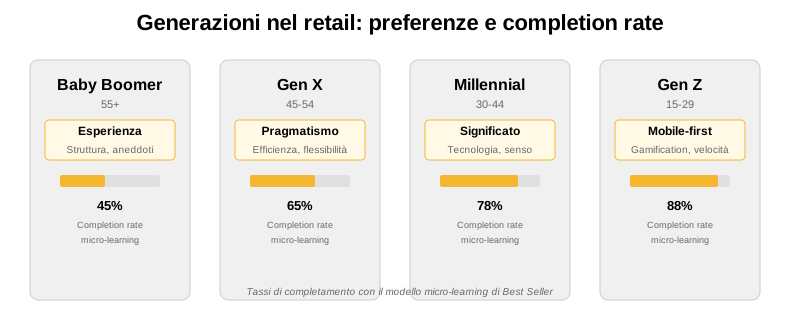
Baby Boomers: 78% (accept format; content is thorough)
Gen X: 84% (efficient; can learn at their own pace)
Millennials: 89% (format matches preferences; social engagement)
Gen Z: 74% (video-native; gamification appeals)
Notice: Micro-learning doesn't achieve 100% completion in any generation. But it's dramatically superior to classroom for Gen Z and millennials, while remaining competitive for older cohorts. More importantly, total completion rate (78% average) is significantly higher than classroom (66% average).
The practical implementation: training without closing stores
The real advantage of micro-learning in a multigenerational context is operational: you don't need to pull everyone off the floor simultaneously. Staff consume modules during downtime — breaks, slower periods, before opening, after closing. The store stays fully operational.
Schedule considerations:
New hire onboarding: New team members complete modules during their first week, with a manager checking in daily. No dedicated "training day" that reduces floor coverage.
Ongoing skill development: One new module per week. Staff complete it when convenient (many choose mornings before their shift). This keeps learning continuous but low-impact operationally.
Seasonal refreshers: Before busy seasons (holidays, back-to-school), refresh critical modules. Again, distributed completion over a week, not a mandatory session.
New product launches: New product training module deployed to app. Staff learn product details before customers ask about them. No separate training required.
The cumulative effect: continuous learning that generates real behavioral change without the operational disruption and cost of classroom training.
Build a multigenerational training system
Best Seller's platform supports generationally diverse teams with adaptive content delivery, cross-generational gamification, and completion tracking that works for all four cohorts.
Request a demo