
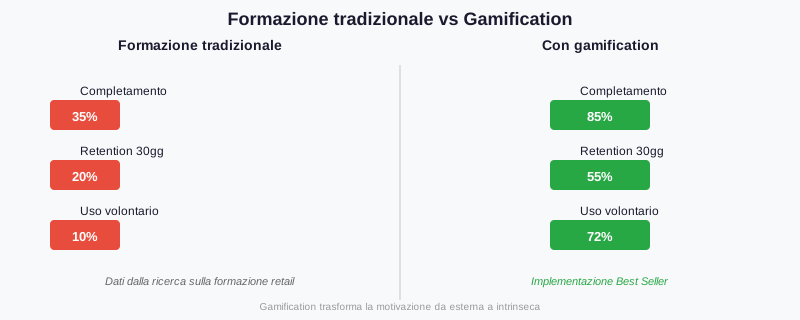
Ask most retail workers about mandatory training, and the response is consistent: reluctance, low engagement, minimal retention. Completion rates often hover around 35-40%. Learners view training as a checkbox obligation rather than valuable knowledge. Yet networks that introduce gamification into training see engagement rates jump to 75-85%, with corresponding improvements in knowledge retention and behavioral change.
The difference isn't better content—it's psychology. Gamification doesn't trick people into learning. It taps into psychological mechanisms that make learning feel rewarding rather than obligatory. Understanding why this works and how to implement it transforms training effectiveness.
The mandatory training problem: why engagement crashes
Traditional mandatory training relies on compliance. Staff are required to complete courses, watching or reading content primarily because they're told to. Compliance motivation is weak. The brain doesn't distinguish between "I did this because I had to" and "I didn't want to do this," which means retention is poor and behavioral change is minimal.
Completion data from retail networks shows 35-45% engagement rates on mandatory training—people finish courses, but their attention is elsewhere. They're thinking about the store, the customer they might be missing, or simply trying to get the training over with. The content enters short-term memory, encounters the forgetting curve within 24 hours, and is largely lost.
The reason for this low engagement is rooted in Self-Determination Theory, the psychological framework explaining motivation. According to this theory, humans are motivated by three psychological needs: autonomy (feeling in control), competence (feeling able), and relatedness (feeling connected). Mandatory training, by definition, violates the first—employees have no autonomy over whether to participate. This immediately crushes intrinsic motivation.
Most training content doesn't activate competence or relatedness either. It's often abstract, disconnected from the employee's actual job, and delivered without social interaction. The result: three out of three psychological needs are unsupported, so the learner defaults to the minimum effort required for compliance.
35-40%
Engagement rate with traditional mandatory training
75-85%
Engagement rate with gamified training approaches
The psychology of gamification: activating intrinsic motivation
Gamification doesn't change the requirement—training is still mandatory. But it changes the psychological context. Instead of "you have to complete this training," the framing becomes "here's a challenge" or "here's progress you can make" or "here's how your performance compares." These reframings activate the three psychological needs.
Autonomy: Even in mandatory training, gamification creates choices. Do you want to tackle the leadership module or the customer service module first? Do you want to attempt the quiz once or multiple times? Do you want to participate in the team challenge? These small choices restore a sense of control within the mandatory structure.
Competence: Gamification makes progress visible and measurable. "You've completed 3 of 10 modules—you're 30% done" is more motivating than completing modules without visible progress. Badges and certificates explicitly signal that competence has been developed. When a learner completes a challenging quiz, getting visual confirmation of achievement ("Expert: Customer Service") activates the competence need.
Relatedness: Leaderboards, team challenges, and social sharing connect learning to relationships. When you can see that a colleague is also working on the same training, or when you're competing in a team challenge, learning becomes social. You're not isolated in a training room watching videos—you're participating in something shared with your team.
These psychological triggers are powerful because they're intrinsic—they activate internal motivation rather than external compliance. Someone engaging because they're building visible competence and progressing toward a badge is motivated differently (and stronger) than someone engaging because they were told to.
The practical elements of gamification that work
Badges and achievements. A badge is simply a visible marker of progress or mastery. Complete a module? Earn a badge. Score 80%+ on a quiz? Earn a badge. These are psychologically powerful because they're concrete, visible, and social-shareable. Employees often want to display badges to colleagues, which creates motivation to earn more.
What makes badges effective isn't the visual design but rather the clarity and attainability. "Expert: Upselling Techniques" is clear and specific. A vague badge ("You're Learning!") has no motivational value. Badges should be earned after clear competency demonstration, not just for participation.
Leaderboards and progress visualization. Leaderboards create friendly competition. They're most effective when showing weekly or monthly progress rather than all-time rankings (which can demoralize people who start late). Leaderboards tap into relatedness and competence needs simultaneously—you see how others are progressing and where you stand relative to them.
Progress bars and completion percentages are less flashy but equally powerful. Knowing you're 60% complete toward a learning goal is motivating in ways that arbitrary completion deadlines aren't.
Team challenges. Rather than individual leaderboards, some networks run team-based challenges. A team that completes all training modules first wins a reward. This activates relatedness (you're achieving with your team) and creates positive social pressure (you don't want to let your colleagues down).
Real rewards. Gamification points or virtual rewards feel hollow to most retail workers. Real rewards—vouchers, gift cards, small bonuses, public recognition, or privileges (preferential scheduling)—create genuine incentive. The reward should be proportional and genuinely valuable to the employee, not a trivial gesture.
Implementation: the common mistakes that kill gamification
Mistake 1: Gamification as decoration without content quality. Adding badges to poor-quality training doesn't fix the training. The content itself must be solid—clear, relevant, practically applicable. Gamification enhances engagement, not content value.
Mistake 2: Complexity that exceeds value. Some implementations create such complex point systems and tier levels that the mechanics become the focus rather than the learning. Simple is better. One earning path, clear rewards, understandable rules.
Mistake 3: Leaderboards that demoralize. If the same person is always last on the leaderboard, gamification becomes demotivating. Make progress visible relative to personal goals, not just relative to others. Show weekly rankings (which reset regularly) rather than all-time, so people always have opportunity to compete.
Mistake 4: Rewards that cost more than their motivational value. Expensive prizes create budget constraints that limit frequency. Many smaller, frequent rewards create more engagement than one big annual reward. A €5 gift card earned monthly is more motivating than a €50 prize earned once annually.
Mistake 5: Abandoning the system after launch. Gamification requires ongoing management. Leaderboards need updating, new challenges need launching, scores need resetting. When the system becomes stale, engagement crashes. Treat it as an ongoing program, not a one-time implementation.
The integration with learning: making gamification serve mastery
The highest-performing gamified training systems don't use gamification to make poor content feel engaging. They use gamification to reinforce learning architecture designed for actual skill development.
This means: quiz questions after every module (with immediate feedback) so learners know what they've mastered. Progression from easier to harder content so badges earned early build confidence for more challenging levels. Multiple attempts at quizzes (not single-chance tests) so employees learn from mistakes rather than being penalized for them. Team challenges based on actual skill application rather than mere completion.
When gamification enhances a well-designed learning system, the effects compound. Employees engage more, retain more, apply more, and perform better on the job. Mystery shopping data from networks implementing gamified training with quality content shows 30-40% improvements in behavioral metrics compared to pre-implementation baselines.
Transform engagement with gamified training
Best Seller's gamified micro-learning platform combines badges, leaderboards, team challenges, and real rewards with quality retail content designed for actual skill development.
Request a demo