
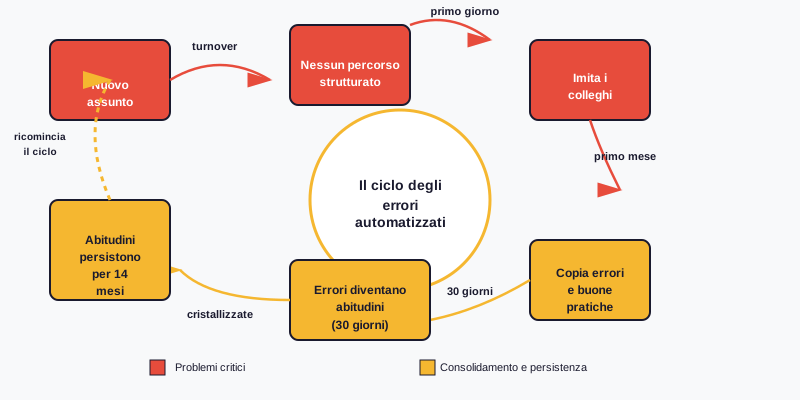
A new hire's first month determines their performance trajectory for months afterward. Without structured training, they watch their colleagues and copy everything—good practices, yes, but also inefficiencies, shortcuts, and bad habits. Within 30 days, those copied behaviors become automated. After that point, changing them requires unlearning, which is exponentially harder than learning correctly from the start.
This isn't just observation. It's neuroscience. And the data across retail networks is consistent: unstructured onboarding creates a permanent performance disadvantage.
The behavioral imitation pattern: why new hires copy everything
When someone new joins a retail team, they exist in a state of high uncertainty. The job is new, the environment is unfamiliar, the customers are unpredictable. In this state, the brain defaults to imitation as a survival strategy. Rather than figuring out the "correct" way to do things from first principles, the new hire observes the experienced people around them and mirrors their behavior.
This is efficient from an uncertainty-reduction perspective. It's terrifying from a quality-control perspective, because it means your new hire is learning your worst practices with the same fidelity as your best ones.
Consider a typical scenario: A new associate starts in a store. The experienced colleague next to them greets customers with "Just let me know if you need anything" and then returns to the register. The new hire mirrors this. Another colleague avoids approaching customers during quiet moments and waits for them to initiate interaction. The new hire replicates this pattern. A third colleague describes products in feature terms rather than benefits. The new hire adopts this language.
By the end of week two, the new hire is indistinguishable in behavior from the people they've been observing. By the end of week four, these imitated behaviors have shifted from conscious choices to automatic patterns—what neuroscience calls procedural memory.
21-30 days
Time for new behaviors to shift from conscious to automatic
4x harder
Effort required to unlearn vs. learning correctly from start
The five mistakes that become permanent: what new hires copy from peers
Across thousands of mystery shopping evaluations, we've identified five behavioral patterns that emerge in unstructured onboarding and persist for months. These aren't random mistakes—they're systematic problems copied from the broader team and reinforced by daily repetition.
Mistake 1: Missing or late greeting. The new hire observes colleagues who don't greet customers within the eight-second window or who greet only after customers have clearly committed to browsing. They copy this. Within a month, the new hire has become someone who waits to see if customers approach them, rather than someone who proactively engages. The research is clear: this costs transaction conversion. Yet it's the default behavior in environments where the experienced team exhibits this pattern.
Mistake 2: Closed questions that prompt "just looking" responses. The experienced team asks "Can I help you find something?" and the customer responds "No, I'm just looking." The new hire mimics this question and gets identical responses. They never understand that open questions ("What brings you in today?") generate conversation while closed questions ("Can I help?") invite dismissal. They're learning a script that guarantees customer disengagement.
Mistake 3: Feature-only product presentation without benefits. The colleague says "This comes in five colors, sizes XS to XXL, made from cotton-polyester blend." The new hire reproduces this script verbatim. They're sharing information, not creating desire. The customer hears a list and zones out. This behavior becomes the new hire's default way of speaking about products, and without intervention, it persists.
Mistake 4: Complete absence of upselling or cross-selling. The new hire observes that the team rarely proposes complementary products. They adopt this pattern. A customer leaves without protective spray for their new purchase, without the accessory that would complete their outfit, without the enhancement that would improve their use case. The new hire learns that this is normal and doesn't try. Transaction value remains depressed.
Mistake 5: Absent or generic farewell. The customer completes the transaction. The experienced team says "Thank you, goodbye." The new hire mirrors this. No "I hope you love this," no "Come back and let me know how it works," no genuine engagement as the customer leaves. The customer departs with no sense that the store values a repeat visit. The new hire has learned that the transaction is the endpoint, not a step in a relationship.
Why the 30-day window is neurologically decisive
The reason the first month is so critical isn't cultural or motivational. It's neurological. Research on habit formation (published in the British Journal of General Practice and replicated across multiple studies) shows that simple behavioral patterns—the kind retail interactions are—become automatic between 18 and 254 days, with an average around 66 days. But for simple actions performed multiple times daily, the process accelerates dramatically.
A retail associate performs customer interactions 20-50 times per shift. That's 100-250 interactions per week. A pattern repeated 100+ times in a month shifts from conscious execution to procedural memory—the brain's system for automatic behaviors. At this point, the behavior no longer requires conscious decision-making. It's automatic, triggered by context (customer enters store) without thought.
Once a behavior is automated, the cognitive effort required to change it increases exponentially. The new hire must consciously override an automatic pattern, detect the moment they're about to default to the old behavior, and execute the new behavior instead. This requires deliberate focus on every single customer interaction, which is cognitively expensive and emotionally draining. Most people revert to the automatic behavior under any time pressure.
The implication is stark: if new hires spend their first month learning behaviors rooted in poor practice from their peers, you've effectively hardwired those poor practices into the organization. Subsequent training fighting against that automation is exponentially less effective than training that establishes correct patterns from day one.
The unstructured onboarding trap: "learning by osmosis" doesn't work
Many retailers approach new hire training as "assign them a buddy and let them learn by watching." The theory sounds reasonable—experienced staff modeling best practice. The reality is that experienced staff model average practice (or below), and new hires absorb it with perfect fidelity.
The buddy system only works if the buddy has been explicitly trained in how to train, is actively monitoring the new hire's behavior, and is providing real-time feedback on what they're doing correctly and incorrectly. Without that structure, what happens is observation and imitation, not learning.
Structured onboarding means: clear training on what correct behavior looks like (video, live demonstration, or both), guided practice with feedback, and consistent reinforcement. It means the new hire understands not just what to do but why—because understanding activates different neural pathways than imitation alone.
The performance cost: long-term impact of unstructured starts
The performance consequence of unstructured first months is measurable. New hires trained in a structured program (clear content, deliberate practice, feedback) reach performance levels of experienced staff within 4-6 weeks. New hires trained through observation and osmosis reach those levels in 12-16 weeks, and even then their baseline performance is lower because the automated behaviors are suboptimal.
For a retail network with regular new hire cohorts, this difference compounds. If you onboard 50 people per month and each person's poor-practice automation costs you 20% performance for 12 weeks, you're dealing with continuous low performance at scale. The cost in lost sales, lower customer experience ratings, and retained inefficiency is substantial.
The solution: structured first-month training that prevents bad habit automation
Preventing bad habit automation requires intervening in that critical 30-day window with explicit instruction that creates correct behavior before the brain can automate incorrect patterns observed from peers.
This intervention needs to be: clear (video content showing exactly what correct behavior looks like), concrete (new hires practice these behaviors multiple times with feedback), and reinforcing (the training is brief and repeated rather than delivered in a single orientation session). Critically, it needs to happen before the new hire spends 30 days watching and copying peers.
The difference is substantial. New hires with structured first-month training enter the second month with automated correct behaviors rather than automated poor behaviors. Their subsequent growth is faster, their long-term performance is higher, and the culture they join is one where new people succeed, not where they gradually absorb mediocrity.
Get your new hires right from day one
Best Seller's onboarding program prevents bad habit automation by establishing correct behaviors in the critical first 30 days.
Request a demo