
A new sales associate starts Monday morning. By Friday, they should be confident handling customers, knowing product basics, and understanding procedures. Not perfect — but genuinely productive. This is achievable. Most stores do it in 3-4 weeks, but structured onboarding can compress this to 7 days.
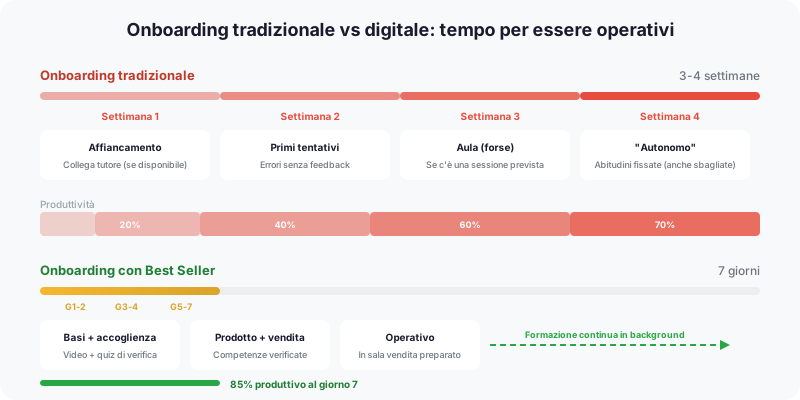
The difference isn't magic or talent selection. It's deliberate process design. Successful rapid onboarding has a specific structure: compressed content sequencing, intense early supervision, and immediate customer-facing responsibility with support. Done right, you move someone from zero to independent contributor in 140 hours rather than 240-320.
The traditional onboarding problem
Standard retail onboarding takes 3-4 weeks because it follows a passive accumulation model. New hires go through orientation, watch some training videos, shadow experienced staff intermittently, and gradually take on responsibility. Progress depends on observation and passive learning. They're supposed to absorb procedures by watching, absorb product knowledge by handling items, absorb customer service by seeing it done. This is inefficient.
7 days
Time to basic independent productivity with structured onboarding
5-6 weeks
Time to full competency and confidence
40-45%
Improvement in new hire retention with accelerated onboarding
The problem: passive learning is slow. The solution: active, structured learning that sequences content, provides immediate application, and creates clear progress markers.
The one-week onboarding framework
Day 1: Context and orientation
Focus on belonging and clarity, not information overload. The first day is psychological: make them feel welcomed, give them a sense of where they fit, show them where bathrooms and break rooms are. Introduce your store's values. Walk them through the physical space. Assign one experienced person as their primary mentor for the first week.
Limit content to essentials: basic safety, time-keeping procedures, the 2-3 most critical store policies. Avoid reading employee handbooks or drowning them in procedures. They won't retain it anyway. You're building comfort and context, not loading information.
Days 2-3: Product fundamentals and greeting
Compressed product training focused on three domains: categories your store specializes in, your best-sellers, and how to find anything else. Not comprehensive product knowledge — achievable domain-specific confidence. Use the actual store, point to things, let them touch them, create associations between products and use cases.
Teach the greeting sequence that your store uses. Have them practice the exact words. Observe them greeting real customers by day 2 afternoon (with their mentor nearby). Yes, they'll be nervous. That's fine. They need to start accumulating customer interaction hours immediately, or they'll spend the entire first month not having talked to many customers.
Days 3-4: System training and transaction cycles
POS system basics: how to ring a sale, how to process returns, how to run card payments. Keep it operational, not comprehensive. They don't need to know seven ways to do something — one way, drilled repeatedly. Transactions completed by day 4: they should have processed 20+ under supervision. Repetition builds muscle memory fast.
Walking through the full customer cycle: greeting, understanding needs, showing products, closing, payment, thank you. No scripts — just the structure. Have them walk through with their mentor using real customers each afternoon.
Days 5-6: Increasing autonomy with presence
The mentor shifts from constant presence to nearby presence. The new person greets customers alone, with their mentor visible but not intervening unless something goes wrong. They're handling transactions independently. They're answering basic product questions. The mentor is still there for difficult situations, product clarifications, and encouragement, but the default is independence.
At this point, they're ready to work a shift mostly alone if necessary. They're slow, they'll make small mistakes, but they're functional. By day 6 evening, they've had 20+ customer interactions where they took the lead, handled transactions, and successfully closed sales.
Days 6-7: First solo shifts with backup
Short solo shifts (3-4 hours) where they're alone but can call a manager with questions. They should experience the full flow of operating without their mentor present. This is confidence-building. They need to know they can do it alone, even if imperfectly. An experienced associate should be available by phone.
What makes this work
The compressed timeline works because it combines three elements: intense personal mentoring (which accelerates learning), immediate responsibility (which creates urgency and relevance), and structured content (which prevents information overload). You're not reducing what they learn — you're changing how you deliver it.
The critical insight: people learn faster when they're doing the job they're learning, not when they're in preparation. Put them on the sales floor with support on day 2, not sitting in the back office watching videos. Watching videos about how to greet customers is informative. Greeting real customers with a mentor is learning.
The mentoring multiplier
This entire model depends on one thing: an experienced person spending 90% of their time with the new hire for the first week. This costs money — you're paying two people to do one job. But the cost is far lower than the cost of having them underperform for 3-4 weeks. Seven days of doubled labor cost is roughly $1,000-1,500. Four weeks of degraded performance costs $3,000-5,000 in lost sales and reduced conversion.
Moreover, assigning a strong mentor builds team cohesion and gives experienced staff a development role. Many of your best people will enjoy mentoring if it's structured and recognized.
Avoiding failure patterns
The biggest mistakes in accelerated onboarding: putting new hires on registers before they understand basic processes (they freeze up), assigning them to customers before they know what your store sells (they look incompetent), and rotating mentors (they never build trust with anyone). Avoid these and you're 80% of the way to success.
Also critical: don't reduce the intensity mid-week. If someone seems to be struggling on day 3, don't pull back on customer exposure — increase mentoring but maintain the customer interaction. Slow learners need more support and more practice, not less practice.
Post-onboarding: the first month
After that first week, you're not done. The person is functional but not yet fully confident. The next 2-3 weeks are about building depth: introducing more complex scenarios, handling difficult customers, expanding product knowledge beyond the basics, learning seasonal or category-specific knowledge. But the fundamental skills are established. They can work independent shifts. They're generating positive revenue.
Continued reinforcement through the second and third month builds competency from "can do it" to "does it well." This is where micro-learning support becomes valuable — short daily reinforcements on specific skills, quiz-based product knowledge checks, and access to reference material when they need it.
Ready to implement accelerated onboarding?
We've built onboarding structures and supporting micro-learning systems for chains of all sizes. Let's talk about adapting this for your network.
Request a consultation