
The choice between classroom training and digital micro-learning isn't really about training philosophy. It's about economics. Both approaches can transfer knowledge. The difference lies in cost structure, knowledge retention, and scalability in environments with high turnover. When you run the numbers, the comparison is stark.
This article walks through a side-by-side economic analysis for a typical retail chain: what each model actually costs, how effectively each achieves knowledge retention, and which produces better ROI. The data doesn't favor one model universally — context matters. But in high-turnover retail, the economic advantage becomes increasingly clear.
Classroom training: the standard model
Classroom training means bringing staff to a central location or doing in-store sessions, having a trainer present, and running structured sessions of 4-8 hours. This is what retail has done for decades. The costs are known: trainer fees, venue rental, materials, catering, and indirect costs like travel, lost sales, and shift coverage.
€164,000/year
Annual training cost — 30 stores, 2 cycles
70-80%
Information forgotten within one week without reinforcement
For a network of 30 stores with 5 staff each (150 people), running two training cycles annually at €1,100 per person per cycle totals €330,000. But this assumes no turnover. With 40% annual turnover (60 people leaving), you're training 210 people to maintain 150. The effective annual cost becomes €231,000 just for the direct training. Add indirect costs — lost sales, logistics, understaffing — and the total approaches €300,000 for most chains.
Micro-learning: the digital alternative
Micro-learning platforms deliver training via brief mobile videos (3-5 minutes each), accessible on smartphones, consumed during work downtime. No venue needed. No travel. No staff pulled from stores. Content is structured to enable knowledge retention through spaced repetition and quiz reinforcement.
€35,000/year
Annual micro-learning platform cost — 30 stores, unlimited users
85-90%
Information retained after one month with reinforcement
A micro-learning platform serving 150 staff across 30 stores typically costs €1,000-2,000 per month (€12,000-24,000 annually) depending on content depth. A fully loaded solution with onboarding, role-specific content, and admin features runs €2,000-3,000 monthly. For this discussion, assume €35,000 annually for a comprehensive platform.
The critical insight: this cost is fixed regardless of turnover. Whether you retain 60% or 30% of staff, the platform cost remains the same. Every new hire gets the same content, using the same platform, at no additional cost. With 40% turnover, you're training 210 people annually on a platform that costs what training 150 would have cost with classroom approach.
Direct cost comparison
| Cost Category | Classroom | Micro-learning |
|---|---|---|
| Platform/content licensing | €3,000 | €35,000 |
| Trainer fees | €45,000 | €0 |
| Venue/logistics | €25,000 | €0 |
| Travel/catering | €15,000 | €0 |
| Lost sales (direct cost) | €65,000 | €0 |
| Total Annual | €153,000 | €35,000 |
| Savings with micro-learning | €118,000 (77%) | |
The direct cost difference is substantial: micro-learning costs roughly one-fourth of classroom training for the same network. But the more important difference isn't in direct costs — it's in effectiveness and scalability.
Knowledge retention: the hidden cost of classroom
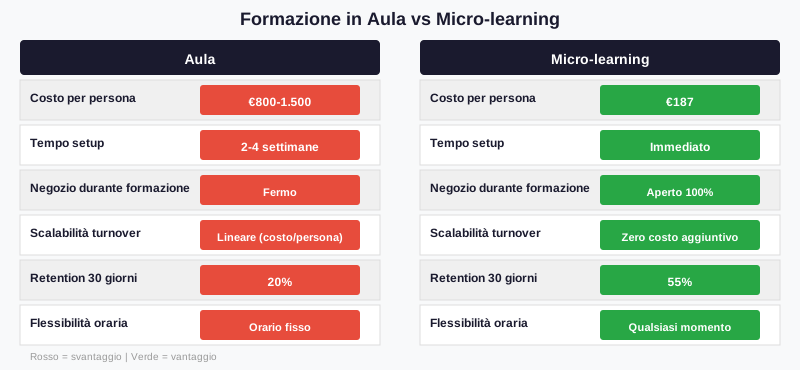
Classroom training suffers from the forgetting curve. Research consistently shows that without reinforcement, 70% of taught information is forgotten within 24 hours and 90% within a week. This means a staff member who completes a classroom training cycle forgets most of what they learned within days.
Micro-learning addresses this through spaced repetition. A topic is introduced in a 4-minute video, reinforced with a quiz the next day, revisited with another brief video a week later, and tested again two weeks later. This spacing and repetition is aligned with how memory actually works. Retention studies show 85-90% information retention at one month with this approach versus 30-40% with classroom training.
Effectiveness with turnover
The structural advantage of micro-learning emerges clearly when you account for turnover. With classroom training, every departure means wasted investment. You trained them, they left, that investment is gone. Every new hire requires new training investment. The cost per competency retained increases with turnover rate.
With micro-learning, every new hire goes through the same content path at no additional cost. The platform is paid for. The content is built. Whether the person stays 3 months or 3 years, you've paid the same training cost. The cost per competency retained approaches a fixed value regardless of turnover.
For a 40% turnover rate: classroom training costs double when you account for training people who leave. Micro-learning costs stay flat.
The implementation advantage
Classroom training requires coordination: scheduling trainers, booking venues, informing staff, covering shifts while they attend. This is logistically complex and staffing-sensitive. Micro-learning eliminates this coordination. Staff train during normal work hours, in small fragments that don't disrupt operations. No store closure. No shift coverage issues. No venue needed.
This also creates a consistency advantage. Every classroom session is slightly different — different trainer, different dynamics, different timing. This variability means inconsistent messaging and knowledge gaps. Micro-learning content is identical across all users and all times. Message consistency is guaranteed.
The behavioral difference
Perhaps surprisingly, staff often prefer micro-learning. Classroom training requires full-day or half-day commitment when they'd rather be working (and earning) in their store. Micro-learning is 4 minutes at a time, flexible, and doesn't feel like "training" but rather brief reference material. This reduces resistance and increases voluntary engagement.
However, micro-learning requires ongoing habit development. Without management reinforcement ("did you complete your micro-learning modules this week?"), engagement can fade. Classroom training is a one-time commitment, making it easier to execute but harder to sustain effectiveness. Micro-learning requires sustained attention but produces sustained results.
When classroom still makes sense
Micro-learning isn't universally better. Classroom training remains appropriate for: complex, scenario-heavy content that requires discussion and live feedback; leadership and soft skills training where peer interaction matters; small teams where economics don't favor platforms; and initial onboarding where personal connection and immersion matter.
The optimal approach for many chains: hybrid. Use classroom for intensive onboarding and complex skills training. Use micro-learning for ongoing reinforcement, product updates, and competency maintenance. This blends the personalization advantage of classroom with the retention and cost advantages of micro-learning.
The ROI reality
The documented ROI difference: micro-learning implementations show 40-80% higher knowledge retention at equivalent or lower cost. This translates to staff who know products better, serve customers better, and generate higher conversion. Studies across retail show conversion improvements of 15-25% following a transition to micro-learning-supported training.
For a 30-store network generating €50 million in annual sales, a 20% conversion improvement on staff interactions (not all sales, just the portion directly influenced by staff knowledge) represents €500,000-1,000,000 in additional annual revenue. The €118,000 saved on training costs is notable, but the revenue improvement from better training effectiveness is the true ROI driver.
Calculate your training ROI
Share your current training spend, network size, and performance metrics. We'll model the micro-learning impact and show the economic case for your specific situation.
Request ROI analysis