
Over two decades of mystery shopping visits across thousands of retail stores, we've documented how customers are served (or not served) at the point of sale. The data reveals something striking: mistakes are not random. Five specific patterns repeat with such consistency that they appear to be structural features of how retail staff naturally behave under the conditions they work in.
Understanding these patterns is essential because they're not about personal competence or attitude. They're predictable behaviors that emerge from how stores operate, how staff are managed, and what incentives exist in the system. More importantly: they're all fixable.
Mistake 1: The invisible customer (40% of visits)
A customer enters the store. They browse. They wait. And no staff member approaches or acknowledges them. This is the single most frequent finding in mystery shopping visits: in 40% of retail interactions, the customer is simply left alone.
The pattern has several recognizable variants. Sometimes staff are genuinely occupied — unpacking merchandise, dealing with a register issue, on a phone call. But in a significant portion of cases, staff are visible and unoccupied yet fail to notice the customer. It's not inattention to a specific customer; it's a form of systematic invisibility that affects 2 in 5 shopping visits.
40%
of visits: customer receives no proactive greeting
15 seconds
optimal window to acknowledge a customer
Why does this happen? Multiple factors: stores are often understaffed; staff lack clear protocols for customer greeting; there's no accountability for who should approach the customer; in some cases, culture has drifted toward "wait to be approached" rather than "approach first." The result is that many customers never move past the entry point.
The sales impact: Invisibility is a customer killer. Research on retail behavior shows that 40-50% of shoppers who browse without any staff interaction leave without making a purchase, regardless of product interest. They don't feel welcomed, and they move on.
How to fix it: The fix requires three elements: (1) a clear protocol — anyone free must greet within 15 seconds of customer entry; (2) staff awareness — knowing that customers interpret silence as disinterest; (3) accountability — tracking greeting rates through mystery shopping. The improvement is immediate and measurable.
Mistake 2: Closed questions (80% of visits)
A staff member does engage with the customer. They ask: "Can I help you?" or "Are you looking for something specific?" These are closed questions. They require yes/no answers and often trigger the response "No, just browsing" — which ends the conversation.
In 80% of mystery shopping visits where staff initiate contact, the opening is a closed question rather than an open one. The difference is crucial: a closed question ("Did you find everything you need?") shuts down dialogue. An open question ("What are you looking for today?" or "What brings you in?") opens it.
This is not about staff being unhelpful. It's the most natural thing to say when approaching a stranger. But it's structurally inferior because it prevents dialogue from developing. The customer answers "no" and staff move on, having fulfilled their greeting obligation without creating any real engagement.
The sales impact: Closed questions significantly reduce the likelihood of upselling and cross-selling. If you never understand what the customer actually wants, you can't suggest what they might need. The conversation stays surface-level.
How to fix it: Train staff on the difference between open and closed questions, provide specific language alternatives, and reinforce through role-play. This is high-impact because it's a micro-behavior change that dramatically improves conversation quality without requiring more time.
Mistake 3: Features-only presentation (75% of visits)
When staff do discuss products, the focus is typically on features: "This one has memory foam," "It comes in three colors," "The battery lasts 12 hours." Features are technical attributes of the product.
In 75% of mystery shopping visits, staff stick to features without translating them into benefits. The critical difference: features are what the product has; benefits are what the product does for the customer. "Memory foam" is a feature. "Memory foam means you wake up without neck pain" is a benefit.
Customers don't buy features. They buy what features will do for their life. A customer shopping for a running shoe doesn't want to hear about the sole's structural properties — they want to know that these shoes will reduce knee strain during long runs, or help them train for their first marathon without injury.
The sales impact: Feature-only presentations feel transactional and educational rather than consultative. They don't create emotional connection to the product. Customers compare based on specs alone, which invites price shopping.
How to fix it: Teach staff a simple bridge: "This product has [feature], which means [benefit] for you." Train them to ask discovery questions first: "What are you using this for?" Then match features to that specific use case.
Mistake 4: Zero upselling (70% of visits)
A customer selects a product and is ready to buy. In 70% of these visits, staff process the transaction without ever suggesting anything additional. No complementary products. No premium versions. No consideration of what else the customer might benefit from.
Upselling is sometimes portrayed as aggressive or pushy, which leads many retail cultures to avoid it entirely. But ethical upselling is actually customer service: if someone is buying a winter coat, mentioning you have scarves and gloves in stock isn't manipulation — it's being helpful.
70%
of purchases: zero upsell or cross-sell attempt
25-35%
typical uptake rate on respectful suggestions
In stores where upselling is practiced, the uptake rate is typically 25-35%. That means 1 in 3 or 1 in 4 customers who were ready to buy accept an additional suggestion when presented thoughtfully. For a store processing 200 transactions per day, that's 50-70 additional sales per day from upsells alone.
The sales impact: The difference is substantial. A store that doesn't upsell leaves 25-35% of sales potential on the table every single day.
How to fix it: Create a simple system: for each product category, identify natural complements. Train staff on when and how to mention them. The key is timing (after the customer has decided to buy, not before) and framing (making it about customer needs, not commission).
Mistake 5: The absent farewell (45% of visits)
The transaction is complete. The customer has paid and is leaving. In 45% of visits, staff say nothing. No "thank you," no "come back soon," no acknowledgment of the customer as a person. The customer simply leaves.
This might seem minor, but it's where lasting impression is formed. Customers remember how they felt at the end of the interaction. A genuine thank you and a smile at the door is the moment that determines whether they return.
Mystery shoppers specifically track whether staff say thank you and make eye contact during the farewell. This happens in only 55% of visits. The other 45% end in transactional silence.
The sales impact: Customer lifetime value is significantly higher for customers who feel acknowledged and thanked. The absent farewell doesn't just miss that moment — it contributes to a feeling that the store views customers as transactions, not people.
How to fix it: This is the easiest fix of all. Set one simple standard: every customer leaves with a thank you and eye contact from the staff member who served them. That's it. Implementation is immediate. The impact on repeat visit rates is measurable.
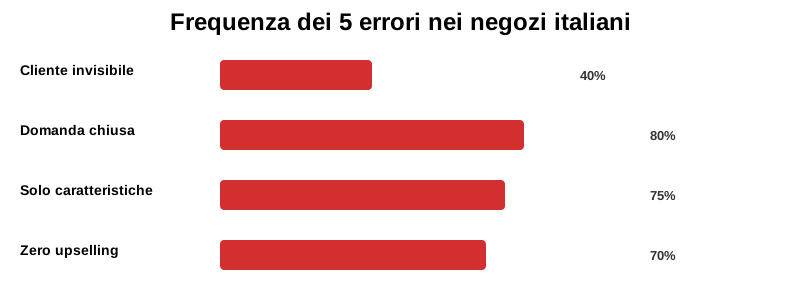
Why these five patterns repeat across stores
These mistakes appear so consistently not because retail staff are poorly trained, but because they're the natural outcome of systemic conditions: understaffing, lack of clear protocols, absence of feedback, and misaligned incentives.
Consider the invisible customer problem. It doesn't exist because staff don't care about customers — it exists because there are three people scheduled for a store that needs five, and those three are managing inventory crises while also covering the register. Invisibility is the system's default state when capacity is exhausted.
Similarly, closed questions dominate because that's what people naturally say to strangers. Without explicit training and reinforcement, open questions feel uncomfortable. Staff revert to what feels safe.
The pattern: These five mistakes can be systematically reduced through a combination of clear standards, micro-learning reinforcement, and accountability through observation (like mystery shopping). But they require ongoing attention. Without reinforcement, staff naturally revert to these patterns because the system doesn't support anything else.
Measure your store's performance against these patterns
Mystery shopping reveals where your staff excels and where the system needs adjustment. We conduct unbiased visits and provide actionable data on greeting, engagement, and customer experience.
Request a demo